It was only a few years ago that I was seeing people in the computer biz lamenting the loss of the word "hack" (and "hacking," "hacker," etc.) Originally, a hacker was a person who used a computer a lot. That is, a programmer was a type of hacker.
But all that changed when the media needed to talk about people who use computers maliciously. They seized on the word "hacker" to describe these people. And this was at a time when the word was still only vaguely understood by the general public. So the word that had been semi-affectionate term for people with a common interest became a scary and slanderous word only a few steps up from "terrorist." Some computer fans tried to rescue "hacker" by promoting the made-up word "cracker" as a replacement for people who break in to systems. That never got far.
But in the past few years, the positive connotations of hacking have made a comeback. Websites like Lifehacker have promoted the word as a more general term for clever, non-standard action. I'm seeing this new (old) use of "hack" in more and more places, so it's safe to say the public has bought in to the idea that hacking can mean positive things.
Saturday, May 30, 2015

Thursday, May 28, 2015
Corrupted File
The world's media has been buzzing about the FIFA officials arrested for corruption. And apparently a lot of the legal work was done by the Americans, even though they are hardly FIFA's most important market. Of course, that could be because they have some objectivity and distance from the problem, sort of like how hockey agent Alan Eagleson's crimes were exposed and charged in the U.S. rather than Canada. Perhaps the Americans could rent themselves out going after corruption in sports they don't care about. I'm hoping they'll tackle Formula One next, and I hear Cricket has some problems too.
And now the story gets stranger. Well, it was stage to begin with that everyone in the organization is on the take and President Sepp Blatter was supposedly not involved, and didn't even know anything bad was going on. But now it's time for the next election for the organization's president. Blatter is not only still running, he's still likely to win.
Each country's national soccer association gets a vote for President. The media is trying desperately to explain how much of the world (largely the non-Western world) will be giving another term to this guy. The reason is usually given that he's been good to the developing world. After all, he did oversee the World Cup coming to Africa.
But quick look at a map of corruption problems shows a disturbing correlation between areas that support Blatter and areas that have corrupt governments. A better way to explain his continued support is this: the sort of person who somehow got a cushy, high-paying job from a corrupt government is the sort of person who supports Sepp Blatter.

Tuesday, May 26, 2015
Afternoon Debate
I remember years ago reading an interview with an exec from TSN, then Canada's only sports network. It was when specialty cable channels were new, and a lot of their programming was Aussie Rules Football and monster trucks. But he was outlining where he wanted the network to go, and he mentioned foreseeing a day when they had an array of "lifestyle" programming related to sports during the day, like exercise shows.
Of course, that didn't happen. Today that seems quite naive and old fashioned, reminding us of a time when: daytime television appealed to housewives, cable channels stayed on topic, and people cared about exercise.
I'm reminded of this because today's daytime sports programming is dominated by sports discussion shows. The people on them change from one hour to the next, but the format is mostly the same, with a relatively-rapid-fire succession of topics to be argued about briefly and discarded. And the shows are quick to apply the tropes of sports coverage, with time limits and on-screen lists of upcoming subjects.
Even in our divisive and sports-obsessed world, I can't believe anyone needs this much sports talk. Each show covers the same stories; how many people do we need to debate one day's sports news? Are you sure no one out there wouldn't rather watch an exercise program?
But somehow this is the most profitable programming for sports networks' daytimes. I guess that's not too surprising - with one set and no writers, they must be dirt-cheap to make. And that's the modern approach to specialty channel programming: find a type of show that will make you money, then crank out as many variations on it that you can get away with.
Of course, that didn't happen. Today that seems quite naive and old fashioned, reminding us of a time when: daytime television appealed to housewives, cable channels stayed on topic, and people cared about exercise.
I'm reminded of this because today's daytime sports programming is dominated by sports discussion shows. The people on them change from one hour to the next, but the format is mostly the same, with a relatively-rapid-fire succession of topics to be argued about briefly and discarded. And the shows are quick to apply the tropes of sports coverage, with time limits and on-screen lists of upcoming subjects.
Even in our divisive and sports-obsessed world, I can't believe anyone needs this much sports talk. Each show covers the same stories; how many people do we need to debate one day's sports news? Are you sure no one out there wouldn't rather watch an exercise program?
But somehow this is the most profitable programming for sports networks' daytimes. I guess that's not too surprising - with one set and no writers, they must be dirt-cheap to make. And that's the modern approach to specialty channel programming: find a type of show that will make you money, then crank out as many variations on it that you can get away with.
Friday, May 22, 2015
My Own Private Israel
There's been some refreshing news from the middle East. No, it's not good news: it's more violence and intolerance. But at least it's small violence and intolerance. No one was even killed this time.
In Israel, a soldier of Ethiopian descent was beaten by police officers. That was a breaking point for Israel's Ethiopian community, and led them to protest their poor treatment. What, you didn't know there were Jews in Africa? Yes, they're everywhere.
This is a depressing situation on many levels. For one thing, this is a country founded to defend a traditionally abused minority, and they've apparently developed a tradition of abusing a minority.
I'm not Jewish, so I've never really grasped the place Israel has in people's psyche. You're part of a minority that's poorly understood if not outright hated, but then there's this place far away that you can go to, where everyone is like you. You go there, and the minority culture you've struggled all your life to explain to friends and colleagues is the majority, the expectation.
(As an aside, above when I described Jews as "poorly understood," my phone interpreted that as "porky understood." I think my phone is anti-Semitic.)
As a straight, white, able-bodied, WASPy, cis male, it's hard for me to relate to that. The closest I can get is to relate it to my my geekiness. It would be pretty nice to have a Geekland that I can go to and feel at home. Geekland? Geekistan? I don't know, we'd probably just call it Westeros.
So you get on a plane as an outsider with interests few others share, then get off it on the other side of the world as an accepted member of the majority. One problem with it is that you have lived in the outside world for so long, that you might feel overwhelmed when you go to the homeland and find you aren't geeky enough. I know I'd probably get deported as soon as they found out I only watched three episodes of Firefly. And sure enough, Israel has similar problems: people come from different denominations and different places, then find that it's hard to reconcile the fundamentalist and liberal believers.
Geekistan wouldn't fare much better. I mean, we don't even have to share the same space, and yet the culture is tearing itself apart online on two different fronts. And that's the problem with having a place for your people: even if you have one major thing common, like a religion, there are still so many ways we differ and disagree, and we'll discover them when we're forced to share the same venues and institutions.
In Israel, a soldier of Ethiopian descent was beaten by police officers. That was a breaking point for Israel's Ethiopian community, and led them to protest their poor treatment. What, you didn't know there were Jews in Africa? Yes, they're everywhere.
This is a depressing situation on many levels. For one thing, this is a country founded to defend a traditionally abused minority, and they've apparently developed a tradition of abusing a minority.
- The Ethiopian Israeli situation is similar to the situation of African Americans: a cycle of poverty, mistrust from the majority, and excessive incarceration.
- Fortunately, Prime Minister Netanyahu has spoken out against the treatment of Ethiopians. That's good of him, but I'm sure I wasn't the only one who read that as, "guy who built his career on demonizing Arabs condemns racism."
I'm not Jewish, so I've never really grasped the place Israel has in people's psyche. You're part of a minority that's poorly understood if not outright hated, but then there's this place far away that you can go to, where everyone is like you. You go there, and the minority culture you've struggled all your life to explain to friends and colleagues is the majority, the expectation.
(As an aside, above when I described Jews as "poorly understood," my phone interpreted that as "porky understood." I think my phone is anti-Semitic.)
As a straight, white, able-bodied, WASPy, cis male, it's hard for me to relate to that. The closest I can get is to relate it to my my geekiness. It would be pretty nice to have a Geekland that I can go to and feel at home. Geekland? Geekistan? I don't know, we'd probably just call it Westeros.
So you get on a plane as an outsider with interests few others share, then get off it on the other side of the world as an accepted member of the majority. One problem with it is that you have lived in the outside world for so long, that you might feel overwhelmed when you go to the homeland and find you aren't geeky enough. I know I'd probably get deported as soon as they found out I only watched three episodes of Firefly. And sure enough, Israel has similar problems: people come from different denominations and different places, then find that it's hard to reconcile the fundamentalist and liberal believers.
Geekistan wouldn't fare much better. I mean, we don't even have to share the same space, and yet the culture is tearing itself apart online on two different fronts. And that's the problem with having a place for your people: even if you have one major thing common, like a religion, there are still so many ways we differ and disagree, and we'll discover them when we're forced to share the same venues and institutions.
Tuesday, May 19, 2015
Darlin', You Gotta Let Me Know
Last week, Britain had an election. The Conservatives won again, though this time with a majority. Since their ineffectual minority partners, the Liberal Democrats, didn't make much of an impression anyway, it's hard to see how this election made any difference.
Outside of Scotland, anyway. One interesting aspect is that the separatist Scottish National Party won nearly every seat in Scotland. So it's official, Scotland is in full Quebec mode: not wanting to work with the rest of the country, but also not quite willing to commit to a split.
Speaking of people who won't quite separate, the big news is that the Conservatives will be holding a referendum on whether Britain should leave the European Union. It's such a big deal, they've even given it the already-grating name, "brexit," for British exit.
This decision should be interesting, since the British have developed a strange relationship with the EU: everyone seems to hate it, bit no one does anything about it. It's fitting that they use the word, "Eurosceptic" to refer to someone who dislikes the UK's membership in Europe, yet you never seem to hear anyone described as simply, "Anti-Europe." Politicians - including PM Cameron have used Europe as a crowd-pleasing punching bag, but now they'll have to put their money where their mouths are.
But I'm not sure they will. Someone over there floated the idea of renegotiation. That is, the idea that, rather than accept the obvious options of stay or go, there's also the possibility that they could just renegotiate the terms of their membership. And that's the second Quebec connection: they've introduced a hypothetical possibility that they can get the best of both worlds through the magic of negotiation.
I'm certainly a fan of talking, negotiation, and compromise. But I recognize that they are limited by the obvious fact that there's another side to the dealings. I'm amazed at how often people get taken in by this idea that they can get anything through negotiation, even when it's clearly something the other side would never agree to.
So this whole process could get frustrating to watch, but at least we'll have the satisfaction of watching the UK simultaneously separator and separatee.
Outside of Scotland, anyway. One interesting aspect is that the separatist Scottish National Party won nearly every seat in Scotland. So it's official, Scotland is in full Quebec mode: not wanting to work with the rest of the country, but also not quite willing to commit to a split.
Speaking of people who won't quite separate, the big news is that the Conservatives will be holding a referendum on whether Britain should leave the European Union. It's such a big deal, they've even given it the already-grating name, "brexit," for British exit.
This decision should be interesting, since the British have developed a strange relationship with the EU: everyone seems to hate it, bit no one does anything about it. It's fitting that they use the word, "Eurosceptic" to refer to someone who dislikes the UK's membership in Europe, yet you never seem to hear anyone described as simply, "Anti-Europe." Politicians - including PM Cameron have used Europe as a crowd-pleasing punching bag, but now they'll have to put their money where their mouths are.
But I'm not sure they will. Someone over there floated the idea of renegotiation. That is, the idea that, rather than accept the obvious options of stay or go, there's also the possibility that they could just renegotiate the terms of their membership. And that's the second Quebec connection: they've introduced a hypothetical possibility that they can get the best of both worlds through the magic of negotiation.
I'm certainly a fan of talking, negotiation, and compromise. But I recognize that they are limited by the obvious fact that there's another side to the dealings. I'm amazed at how often people get taken in by this idea that they can get anything through negotiation, even when it's clearly something the other side would never agree to.
So this whole process could get frustrating to watch, but at least we'll have the satisfaction of watching the UK simultaneously separator and separatee.
Sunday, May 17, 2015
Astro Down Memory Lane
The Blue Jays' recent series in Houston didn't go well for them. But I did notice something interesting in the crowd: the preponderance of old Astros shirts.
To review: Houston's baseball team was originally called the Colt 45's. But when the city built the world's first domed stadium, it was named the Astrodome, in honour of the city's connection to the space program ("Houston, we have a problem.") Also, it was the 60's, and the future was still cool. So the team chose the name Astros. They also started taking their logos and uniforms in a bolder direction, by the mid-70's, they adopted snazzy white, orange, yellow and red uniforms, with an unapologetically modern font (Futura Bold?) Of course, traditionalists cringed.
Over the last quarter-century, the Astros have had a variety of inoffensive, but unmemorable uniforms and colour schemes. Today, their current black-and-orange unis hint at the old ones, but the traditional trim and fonts are incongruous.
But the weird thing is that you still see a lot of the gaudy old shirts in the stands. In fact, it seems like there are more of them than their current style. So essentially the fans have spoken, and whatever the marketers say, they think their team identity lies in those crazy 70's shirts.
Hopefully the team will realize this and build on it. I'm not expecting them to go back to that style, but they could come up with a design that pays tribute while looking more timeless. Essentially, the Blue Jays did this on a less extreme scale, bringing back their World Series era logo, fonts, and uniforms, albeit with some well-placed updates (it's amazing what a difference serifs make.)
I'm glad to see this. While baseball's history and tradition give it a gravitas most sports lack, it can get rather stuffy when self-appointed gatekeepers decide what is and isn't available. It's good to see that the sport still has room for a little irony.
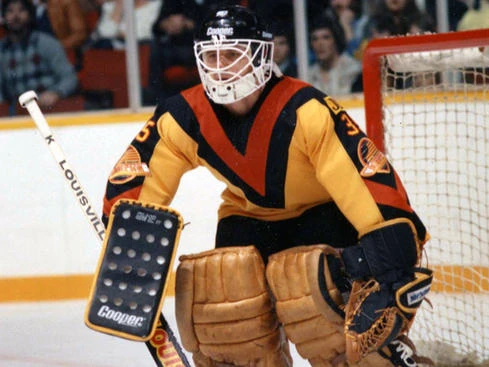
And if there can be rehabilitation for the Astros' notorious uniforms, maybe some others have a chance. The Raptors' old purple shirts still make a lot of appearances in the crowd, despite their tasteful current red and black. The Washington Capitals have brought back their outlandish star-spangled shirts. But the ultimate would be if the Vancouver Canucks and their fans warm to their old black, red, and yellow.
To review: Houston's baseball team was originally called the Colt 45's. But when the city built the world's first domed stadium, it was named the Astrodome, in honour of the city's connection to the space program ("Houston, we have a problem.") Also, it was the 60's, and the future was still cool. So the team chose the name Astros. They also started taking their logos and uniforms in a bolder direction, by the mid-70's, they adopted snazzy white, orange, yellow and red uniforms, with an unapologetically modern font (Futura Bold?) Of course, traditionalists cringed.
Over the last quarter-century, the Astros have had a variety of inoffensive, but unmemorable uniforms and colour schemes. Today, their current black-and-orange unis hint at the old ones, but the traditional trim and fonts are incongruous.

But the weird thing is that you still see a lot of the gaudy old shirts in the stands. In fact, it seems like there are more of them than their current style. So essentially the fans have spoken, and whatever the marketers say, they think their team identity lies in those crazy 70's shirts.
Hopefully the team will realize this and build on it. I'm not expecting them to go back to that style, but they could come up with a design that pays tribute while looking more timeless. Essentially, the Blue Jays did this on a less extreme scale, bringing back their World Series era logo, fonts, and uniforms, albeit with some well-placed updates (it's amazing what a difference serifs make.)
I'm glad to see this. While baseball's history and tradition give it a gravitas most sports lack, it can get rather stuffy when self-appointed gatekeepers decide what is and isn't available. It's good to see that the sport still has room for a little irony.
And if there can be rehabilitation for the Astros' notorious uniforms, maybe some others have a chance. The Raptors' old purple shirts still make a lot of appearances in the crowd, despite their tasteful current red and black. The Washington Capitals have brought back their outlandish star-spangled shirts. But the ultimate would be if the Vancouver Canucks and their fans warm to their old black, red, and yellow.
Friday, May 15, 2015
Faith No More
I saw this interesting new study on the popularity of religions in the USA. That is, they polled people on what they said their religion is. I'll give you the quick version:
A couple of interesting things stand out to me. One is how universal the dripping Christian numbers are. The impression I had was that moderate denominations were leaking members on both sides, with people either leaving churches all together, or getting drawn to more conservative sects. This would lead to a "hollowed out" religion made up of the fundamentalist and the lapsed with few in between. But that's not what's happening. It does appear that liberal denominations are losing members to the conservative denominations, but that's small compared to the numbers they're both losing to "none of the above."
The other interesting point involves those people who say they aren't a member of any church. The survey has options for "atheist," "agnostic," and "none." While all three have been gaining, there are far more people in the last category (at 3.1%, 4.0%, and 15.8%, respectively.)
That could mean a number of things:
Fortunately, they say future research will look into that, it seems like a big distinction. Among young millennials, self-described Christians make up only 56% of the population, so this is a pretty big slice of the population for us to not understand.
- All Christian denominations have declined in popularity (as determined by the percent of the population that considers themselves a member.) Though Christianity still makes up a big majority.
- The proportion of white people has declined in almost all Christian denominations.
- Non-Christian religions have nearly all gained, though their numbers are still small.
- The member of people saying they belong to no religion has increased fast. And young people are more likely to have no religion, and are leaving religions faster.
A couple of interesting things stand out to me. One is how universal the dripping Christian numbers are. The impression I had was that moderate denominations were leaking members on both sides, with people either leaving churches all together, or getting drawn to more conservative sects. This would lead to a "hollowed out" religion made up of the fundamentalist and the lapsed with few in between. But that's not what's happening. It does appear that liberal denominations are losing members to the conservative denominations, but that's small compared to the numbers they're both losing to "none of the above."
The other interesting point involves those people who say they aren't a member of any church. The survey has options for "atheist," "agnostic," and "none." While all three have been gaining, there are far more people in the last category (at 3.1%, 4.0%, and 15.8%, respectively.)
That could mean a number of things:
- They're Christian, but don't feel right saying they belong to a particular church given that they haven't been there since childhood.
- It could be that these people still have some religious beliefs, but they don't fit into Christianity.
- They are no longer sure what they believe in, as with people who give that cryptic description "spiritual, but not religious."
- They don't know what "atheist" or "agnostic" mean.
- They're straight-up atheist, but even they are turned-off by the the attitude of the new atheist movement.
Fortunately, they say future research will look into that, it seems like a big distinction. Among young millennials, self-described Christians make up only 56% of the population, so this is a pretty big slice of the population for us to not understand.
Subscribe to:
Posts (Atom)