Showing posts with label baseball. Show all posts

Friday, December 15, 2023

What A Show, Eh?

See, if the Blue Jays had succeeded in signing Shoehi Ohtani, then that headline is the pun we’d all be getting tired of. Aren’t you glad we dodged that bullet? No, me neither.

It's been a weird offseason for the Blue Jays. It started with a sense of doom:  The team has kind of painted itself into a corner: Several players have expiring contracts, and the team’s offence needs improvement, but there isn’t a lot of offence available in this year’s free-agent class. There was a sense that there was little to look forward to.

Then, unexpectedly, the Jays made a major push to sign Shohei Ohtani. This is a team that has rarely gone after the top free agents, and then they go after the biggest free agent ever. Even though the contract was expected to be at least three times the biggest contract the Jays had ever signed. Nevertheless, as the rumour mill’s list of suitors dwindled, and the Blue Jays slowly rose to the top of the list of potential destinations.

And then, suddenly, it was over. It was like reality reasserted itself, and Ohtani signed with the Dodgers just as everyone expected. Of course, it's entirely possible that the chances of his signing with the Jays was always remote, and it was exaggerated to drive the final price up. For Jays fans it was doubly a let down, missing out on Ohtani, and him signing with a super-rich team, as if to emphasize that fantasy time was over now. Okay, it was refreshing that it wasn’t a super-rich team in the Jays’ division for once. I heard some people suggest that Ohtani’s contract decision was a missed marketing opportunity for Major League Baseball, and they should have made it into a televised spectacle, like LeBron James' first free agency. But it seems to me that would be a disappointment, seeing as the result was so predictable.

(And fittingly, my first attempt to spell Shohei was autocorrected to "Sorry")

The whole experience was very strange, and I'm not sure how to describe it. It was like we jumped into an alternate universe, then got pulled back to reality. The effect was similar to watching this video, which hinges on the odd fact that Tom Brady was drafted by the Montreal Expos:

Unfortunately, the timelines of that alternate reality don't quite line up, since Larry Walker left as a free agent a few months before the Expos drafted Brady. But that's part of the experience I'm trying to describe: surreal dreaming, and now back to a dull reality where you realize that dream wasn’t really possible. But after being allowed to dream, it seems extra depressing. 

On a practical level, the Blue Jays are back in the predicament that began the offseason. But on an emotional level, this incident contributes to a long-running frustration for Jays fans: we'd just like to know what type of team we have. There are big-spending teams like the Yankees and Dodgers, cheap teams like the Rays or Royals; some teams spend strategically, like the Cardinals, and some spend wildly, like the Mets. The Jays, on the other hand, seem to jump between personalities. 

They spent big in the World Series years, then turned into a small-market team for a couple of decades. That was at least predictable. Since then, it's been a crap shoot. They might spend big, or not. They might try patiently building a team of talented youngsters. Or they might go after the biggest free agent in the history of sports. I just wish we could adjust our expectations.

Monday, February 25, 2019

Put On My Thinking Cap

Normally, I’m a believer in the concept of the salary cap. But I’m now noticing things that are kind of unexpected. Basketball has a salary cap, but teams are thinking more and more in terms of building through big fee agent signings. The most extreme example being when the Knicks traded young superstar Kristaps Porziņģis so they’d have more money to go free agent shopping this summer. In contrast, Baseball has no salary cap, yet dozens of free agents remain unsigned at the start of spring training because there’s little interest from teams.

How did we get here? Mainly it is a result of the NBA’s relatively low maximum on individual salaries. That is, it’s low compared to the total salary cap, and the small number of players on a basketball team, and the very small number of players who make a difference in a superstar-focused sport. It’s a real distortion of the market: if salaries were free (other than the limit of the salary cap) star players would be paid much more than they are now: In the NBA, a superstar is a huge advantage, so teams would be paying large percentages of their cap for one player to build around. That would drive the salaries of star players through the roof, with the result that no team would be able to fit more than one or maybe two under their cap. Super teams with many superstars wouldn’t exist.

The irony is that now things are looking bad for small teams. As others have pointed out, if a player can only make so much money from salary, then that means there’s a big financial advantage to play on a team that’s either in a big city or is already successful, so they’ll have more chances to do endorsements and supplement the salary. So strangely, while the salary cap may help smaller-market-teams compete, artificially keeping the maximum salary low is hurting them.

It’s a very different dynamic than other sports: in baseball and hockey, there’s a huge emphasis on youth. In baseball, young players are a way for small-market teams to compete without breaking the bank, and in hockey, it’s a way to get value out of the cap. You wouldn’t see anything like the Knicks trading a young star to get cap space so they can sign veterans. On the other end of that trade, people were complimenting the Mavericks on getting two great young players to build around. But I’m wondering what good that is. They may end up getting crushed by a hastily-assembled team of veterans.

Meanwhile, baseball had its own strangeness: no one wants to sign free agents. That’s strange in a sport that used to be dominated by rich teams with expensive players. Many people are blaming this on collusion, a conspiracy of the owners agreeing not to sign anyone. That's happened before, so it's hardly tinfoil hat territory.

But I have to disagree. I don't have much faith in the morality of team owners either, I just think there's a simpler explanation. The fact is that with modern statistics, we know that a good-but-not-great player will only add two or three wins for a team. And while it’s true that more wins generally means more fans (and thus more money) a small improvement like that won’t make a big enough difference to be financially worth it. Say you’re a .500 team: signing one of these “good” free agents would mean spending $10 million a year to go from 81-81 to 83-79. There’s no way that makes financial sense. Sure, you could pay for several of these players to improve the team enough to get into the playoffs, but then you’re talking about spending about $50 million a year just to get into the wild card game.

Baseball’s high costs and hard-to-make playoffs have lead to an all-or-nothing approach by the teams, in which they either spend big to make a great team, or emphasize the farm system to slowly groom a winner. That means the market for mid-range free agents is very small. Teams waiting for the youngsters to develop don’t want free agents because they aren’t trying to win at the moment, and once those youngsters are ready, they don’t want many free agents, because they have a team full of young, talented, and inexpensive players. And the few rich teams have spent most of their money on superstars, and have little need for good players. So if you’re a good player at age 30, there simply aren’t many people looking for your services.

So now the business of sports is even stranger than it normally is. Basketball has a salary cap but may be about to grind into a no-parity rut, while Baseball has no salary cap, but is very frugal, but still has no parity. And I continue to think that the NHL may actually have the best system.

Tuesday, March 6, 2018

In Between Jays

This coming baseball season is shaping up to be strange in at least one way: how few teams are trying to win. I saw one article that pointed out that fewer than half of teams will actually be putting in an effort to compete, with the rest in mid-rebuild, and going through the motions while building up a collection of prospects.

That's a bit of an exaggeration, since their list of rebuilding teams counted teams like the Blue Jays that are half-heartedly competing, neither trying to improve the roster nor rebuilding. But then, you know that if they aren't fast out of the gate, the clearance sale will begin.

It's not hard to see why this is happening. The last three World Series winners (Royals, Cubs, Astros) have shown us the optimum strategy: grooming a generation of prospects to peak at the same time. Teams that do this have a clear enough advantage that there isn't much point shuffling along with a mediocre line-up and hoping for the best.

On the one hand, that's refreshing: we went through twenty years of feeling it was futile to compete with big spending teams, so a change is welcome. Now it's futile to compete with great farm systems. The problem is that while this trend has produced some impressive teams - and allowed some smaller markets a better chance to compete - it's not very entertaining if half the teams are just biding time while they wait for tomorrow's stars to mature. And people are starting to notice.

To understand this, we have to go back to the question of why we watch sports. We may want to see our favourite teams win, and we may enjoy it when they win championships, but the truth is that most of the enjoyment of sports comes from seasons where your team is somewhere in the middle. They aren't world-beaters, but they aren't terrible either. You feel like you might compete if things line-up right for you. And it's good that you can enjoy those mediocre seasons, because that's where teams usually spend most of their time.

But if you're in a cycle of compete-selloff-rebuild-compete, then you never have those seasons. You have meaningless seasons of waiting punctuated by a few seasons of greatness. Those winning periods are nice, but the point is that you never go into any seasons with any intrigue. And if the whole league is using that same strategy, then there's not much to talk about, other than asking which of the four teams peaking this year are going to win.

It's similar in basketball, though not for the same reasons. Here in Raptorland, it's pretty strange. The team is first in their conference, in a season where the big obstacle, the Cavaliers, are looking beatable. You'd think that any team in our situation would be dreaming about winning it all. And yet, no one is talking about that. The most you hear is discussion of how we have a realistic chance of winning the Eastern Conference. No one is planning a championship parade; no one is even acknowledging the possibility.

The NBA may not be locked into baseball's extreme-makeover pattern, but in the same way that it's remarkable how few baseball teams are trying to compete, it's amazing how few basketball teams are true contenders.

But the other two big-four sports are at the opposite ebb. The NFL has had a great deal of parity for a while now. But this year we saw breakthroughs by the Eagles, Jaguars, Bills, Saints, and my Rams. That underlined the fact that coaching changes and under-the-radar personnel choices can have a big effect on a team's fortunes. For an NFL fan - as long as your team doesn't rhyme with "frowns" - You know that competitiveness could be right around the corner.

Meanwhile, hockey has so much parity that an expansion team is contending for first overall. That's got to have fans everywhere thinking that getting a competitive team is easier than they suspected.

For the last decade plus, the formula for success in the NHL has been to draft and develop a few superstars, keep them for the long-term while cycling through a succession of supporting players, holding on to them for as long as you can afford them. It was a nice system, since it rewarded planning by a well-run team, but unlike baseball, you could keep the core of a successful team together for a while, instead of selling-off the entire team and starting over after just a few years of contention.

But now, some teams with stars are failing. The aforementioned expansion Golden Knights are essentially a team that's nothing but a supporting cast, and it is succeeding. It could just be a fluke, or maybe they've stumbled across a whole new way of building a team. Who knows where that's going to go, but it certainly sounds more interesting than the baseball situation.

Tuesday, January 9, 2018

Fairly Deal Stanton

For a few years there, it really seemed like baseball was fun again. Of course, locally that was because the Blue Jays were finally competitive, but even outside of that, things seemed different. The Royals win in a small market with a hard-working team. The Cubs finally ended their century-long drought, thanks to a team of rising stars. Then the Astros' clever rebuilding finally paid off. Even hateable over-spenders like the Yankees and Dodgers succeeded with likeable young talented players that were easy to root for.

But then with this Giancarlo Stanton trade, it was like bad baseball reasserting itself. If you're not familiar with it, here's what happened:

  • New owners Bruce Sherman and Derek Jeter bought a team they couldn't really afford, going deeply in debt
  • Through either incompetence, or a desperation to get rid of the previous, widely-hated, owner, the league approved the sale anyway.
  • Because of the debt, the new owners couldn't afford the salary of Stanton, the team's star.
  • Because his rich contract included a no-trade clause, Stanton could veto any trade destination, and he demanded that the only team he'd go to would be the Yankees.
  • Bargaining from a position of extreme weakness in which everyone knew they had to make a trade and it had to be with the Yankees, the Marlins hardly got anything in return.
  • rather than try to win over the fans, co-owner/spokesperson Jeter has gone into hiding, not even showing up for the recent winter meetings.

It's hard to imagine one story having a bigger collection of bad memories from the last twenty years. At least without mentioning steroids. Look at what it's done:
  • the Yankees are back to being the Evil Empire.
  • one of the game's biggest stars has been revealed as a Kevin-Durant-type looking for a shortcut to a championship
  • widely-loved superstar Jeter trashed his reputation in one move
  • a team that was already having attendance problems has had the third firesale of its brief existence, and the second time they've done that without any success first.

Now the trade is having cascading effects elsewhere. Fellow denizens of the AL east, the Tampa Bay Rays, had been the poster child for competitive small-market teams, but they traded their best player, Evan Longoria. Since he was signed to a team-friendly contact, trading him would seem to be the ultimate sign of giving up for the near future.

I'm worried about where the Jays are going in all this. Just before the Stanton trade, officials from Rogers - the team's owners - admitted they were considering selling the team. Combine these two stories, and one worries that not only are we going back to a late-nineties where our division rivals outspent us year-in, year-out, but we might even be headed down the same road as the Marlins. Thought it's existence, the Jays have always been owned by corporations (first Labatt's, then Rogers.) That's unusual though; traditionally, baseball teams have been owned by individuals. And now Major League Baseball has said that is the only way it will be in the future: they'll only approve individuals as owners, rather than corporations. That has people wondering, how many people in Canada could afford the $1 billion+ cost of the Blue Jays.

So now I'm worried that we're starting the same story, with the sale to someone who can't really afford the team, who'll have to turn it into a low budget, hope-the-prospects-are-good-eventually bottom-dweller. Going into this offseason, there was talk of trading Josh Donaldson to the Cardinals, and I had this whole argument I was going to put into a post about why that would be sending the wrong message, but now people are treating it like a foregone conclusion that unless the team gets off to a tremendous start, he's gone and the rebuilding begins.

It seems to me that the media is seeing things differently than the rest of us. Reporters are a lot more willing to accept the idea that the Jays will be rebuilding. I think it comes down to a subtlety of how the last few years of competitiveness have been perceived. For most of us fans, it wasn't just, "Yay, we're winning!" it was, "Yay, things are back to normal!" We weren't just successful, we felt like a real team again. The idea that we could be relegated back to being a have-not in perpetual rebuilding will be hard to take, even if brief periods of success are guaranteed.

Sunday, September 24, 2017

Kneel Before Sod

The situation in North Korea is still tense. And Puerto Rico's infrastructure was devestated by hurricane Maria. But here we are talking about football players kneeling. Well, that's what Donald Trump wants to talk about, and everyone else is following along. I'm guessing that's because unlike North Korea, Puerto Rico, and the Obamacare repeal, this is something where there's a chance to fight back.

Some have suggested that Trump made the condemnation of NFL players kneeling for the anthem as a distraction, so we won't notice the health care disaster, or because he knows that there's incriminating Russia evidence about to drop. But the world just doesn't seem to work that way any more. We're used to new megastories coming at us every few hours; we can easily drop one story for another whenever we need to. Honestly, I'm not sure why I'm writing this article late at night; there will probably be a new outrage by morning.

The real reason for Trump's attack is that it's a great issue for him to score points with his base. It's got everything he likes: nationalism, condemning dissent, and a racist subtext. The whole thing is not very surprising really. What is interesting, though, is that the way each sport has responded has illustrated the sport's personality.

Football

I was pleasantly surprised by the reaction. A lot of players protested, there didn't seem to be much anger. There was even some official sanctioning, including the anthem singer himself kneeling in Detroit. No one seems to have been fired over this, or even much anger expressed by the owners (though give them a few days.) And there was thankfully little of the feel-good avoidance I complained about previously.

Having said that, the guy who started it all, Colin Kaepernick, is still without a job. So teams and owners' tentative support of their players comes with a big dose of hypocracy. Which is typical NFL too.

Basketball

The NBA and Basketball's culture clearly won the weekend. Trump looked desperate when he revoked Steph Curry's unaccepted invitation to the White House. And the Warriors' decision to "celebrate equality, diversity and inclusion" in Washington in place of a White House visit was a bold response. And Lebron James's Twitter burn of Trump was something Kim Jong Un could only dream of. Come on, NBA stars, I'm trying to hate you. Stop acting like the only adults in the room.

Hockey

The NHL isn't really involved, but somehow managed to turn the incident into a public relations loss by choosing now to announce that the Stanley Cup Champion Pittsburgh Penguins will still be visiting the White House. It's just like them to find a way to lose a controversy they weren't involved in.

Having said that, I will forgive the NHL and become a Penguins fan if Yevgeny Malkin spends the entire visit acting like he's only there to pass on Putin's latest instructions to Trump.

But this is also typical of the paradox that hockey culture hates to rock the boat. It's a sport that takes bravery to play, yet never seems to generate bravery away from the rink among its players.

Baseball

It seemed kind of separated from the rest of the sports world. After all, it is the most conservative, traditional, and increasingly the whitest sport. So it seemed almost like an afterthought when news came out that A's catcher Bruce Maxwell knelt for the anthem. We were like, oh, right, baseball players might be doing that too.

But going back to the hurricane: given Trump's lackluster reaction, you have to wonder how many Puerto Rican players don't feel like standing for the anthem right about now.

Nascar

In sharp constrast with the other sports, Nascar was totally on board with Trump. Legendary car owners Richard Petty and Richard Childress both said they would fire any employees who didn't stand for the anthem - to my knowledge, the only owners in any sport to follow Trump's advice.

Of course, this is just the latest example of how Nascar is fine with being exactly what everyone expects it to be. It's like they want to make it really clear whether you are welcome in the sport or not. Certainly I'm feeling happier with my decision to walk away from it.

Saturday, July 22, 2017

Big Hands, I Know You're The One

For non-obvious reasons, baseball has seen an epidemic of blister problems for its pitchers. Having not spent much of my life throwing baseballs around, I could never wrap my head around the idea that you could throw them enough to cause blisters, but it's been an occupational hazard through the history of the sport. But this year, it's suddenly worse, and affecting pitchers who hadn't previously had such problems. You may not realize it if you're just following one team, but it's been widespread.

Why would this be? Is not clear, but people are putting it together with the other thing we've seen an explosion of this year: home runs. The increase in home runs is sudden and widespread, so a drug-based explanation seems unlikely. So if the players aren't juiced, the assumption is that the balls are. Officially, there has been no change to the design and manufacture of balls, but that would explain both phenomena.

Well, I hope someone figures out what is going on and fixes it. Partly, that is of course because the Blue Jays are particularly hurt by blisters, with young ace Aaron Sanchez just placed on the Disabled List for an incredible fourth time this season, all for blisters. But even worse than nuking my team's pitching rotation, I don't think I can take another description of blisters.

I'm used to hearing commentators and journalists giving dry, medical descriptions of injuries, using vague, bland terms. But now I'm hearing talk about skin and blood. Yes, I realize that most sports injuries are far more painful than a blister. But most viewers have never torn a ligament, so we can listen all day to talk of anterior this and medial-collateral that. But get into nails and pus and we're squirming.

So I guess we all owe hockey an apology. Many have ridiculed how hockey teams try to protect their players from exploitation by reporting injuries as vaguely as possible. Usually you get no more that "upper body injury" or "lower body injury." Now, I guess that's no so bad. I'd hate to imagine detailed reports of hockey injuries.

Also, medical science needs to get to work on better treatments for blisters. It's kind of weird that elbow problems can be fixed by now-routine Tommy John Surgery. Perhaps they can develop a procedure that makes you blister-proof. Just think, years from know you'll hear about pitchers needing Aaron Sanchez Surgery.

Wednesday, November 2, 2016

Things The Teenage Me Would Never Have Believed About Life In The Future, #34

The Cubs will eventually win the World Series.

I don't have a joke about this.  But it does fit the category better than just about anything.

Sunday, October 2, 2016

Mighty Vocal People

With the baseball season winding down, people are talking about who's going to win the MVP awards. Of course, I was hoping that Toronto's Josh Donaldson would win for a second straight year, but he fell out of the running after he joined most of his teammates in taking September off. My next choice would be the Astros' Jose Altuve, since he is, like me, both short and not a member of the Boston Red Sox.

But like any discussion of MVP awards, we also have a debate of the definition of Most Valuable Player. You might think that it is tantamount to the best player. But the "most valuable" player could just be the player who makes the biggest difference to their team. But then, the player that makes the biggest difference could just be the only good player on a bad team.

It can be a frustrating argument. Yes, I know, part of the fun of sports - especially baseball - is the arguing about it. But in this case, it's arguing about what we're arguing about, and that's never fun. But it gets worse, because in the past few years, a lot of people go into the baseball MVP discussion with the argument that Mike Trout is the best player in baseball, so he be MVP. That's despite the fact that Trout trails probable-winner Mookie Betts in just about all offensive categories.

I've heard a few people make a similar argument in basketball, calling for LeBron James to be the default MVP as the best overall player, even if Steph Curry had the best season. Essentially the argument is that James and Trout should win the award year-in, year-out, until another player surpasses them in general talent.

So the MVP could be the player who had the best season, the player who made the biggest difference, or the best overall player, even if he doesn't have the best season this particular year. Just what we need, a third definition.

I guess this idea is a result of our celebrity culture, where the designated star gets to be the centre of attention, with details like reality not mattering. But another contributing factor is the weird place baseball occupies in American culture right now. As I mentioned once before, baseball has become a local game, where fans care about their own team, but not the sport in general. That's unfortunate for someone like Trout: as a generational talent in a popular sport, he should be the most popular guy in America. But most baseball fans care more for their own team's utility infielder.

This situation seems to be frustrating baseball journalists. They're trying to give credit to a star player, but no one seems to be listening. And they have to worry for the long-term health of a sport that's traditionally been defined by individual stars. So sometimes their efforts to laud young talent at every opportunity sounds a bit heavy handed.

Thursday, May 26, 2016

Sports Inversion

A few years ago, I remember a Toronto sports journalist ask the question, what is the second most popular team in the city? The Leafs were far and away the most popular, while the Jays were still in their generation-long post-World-Series doldrums. The Raptors were post-Vinsanity, pre-We-The-North, and Toronto FC was only just getting started.

Now things have changed: the Leafs are still pretty popular, but their deliberate rebuilding process has taken their fan support off the boil. The Jays' fan support of the 80's and 90's have been reawakened. And Raptor fanaticism during their recent success has been a shock to the city and the NBA alike. Even Toronto FC finally has success and star power. Oh, and I'm pretty sure the Argos are still in business too.

It's interesting, because it's always seemed like the Leafs' fandom is a different animal from Toronto's other teams. Yes, many of the fans of all these teams are the same people. But there seems to be a different culture to them. Anecdotally, the Leaf fans are whiter and richer, and I think maler. But there's also the way the media looks at it. It's been clear for the last twenty years or so that hockey coverage comes first, then everything else is a second-class citizen.

The is important to me, because of where I fit in to it. Demographically, I fit in with the hard core Leaf fans. Yet, that's not where my greatest passion lies. I grew up during the darkest years of the Harold Ballard era. Back then the Leafs were bad year-in, year-out. It was actually worse than their recent futility, since there wasn't even the hope of getting better. You just accepted that they were awful and always would be. It didn't help that this was in the era when you only got one or two televised games a week, so the only hockey we could get were the pathetic Leafs losing to slightly-less pathetic Norris Division rivals. Meanwhile, tremendous Oiler and Islander teams were making history, but we could only dream about what their games were like. So I came to resent the Leafs.

But eventually Ballard died, and some clever trades got them in contention. They had some great runs in the playoffs, the fan base was re energized, and I got caught up cheering for them along with most people in the area. So I've been a fan since, but I don't have the same deep connection that many others have. I'd like to see them succeed - which would be the basic definition of a fan - but I wouldn't be that torn-up if they didn't. A few years ago, it occurred to me that a Leafs cup win would be a huge cultural force; I've complained in the past about the ever-increasing legend of the Summit Series, but a Leafs cup win would be ten times that. So I asked myself, would that be worth it? And I said, no, I don't think watching the Leafs win the cup would be worth having to spend the rest of my life listening to Leaf fans go on about how that was the greatest moment in Canadian history.

Anyway, it's a bit of a mystery to me why Leaf Nation is so passionate today. You'd think they'd have a "lost generation" of jaded fans like myself. And yet, the fan base has seemed to become more fanatical over time. I don't understand why, but Canadian hockey fandom in general, and the Leafs in particular, has seemed stronger in spite of mediocre play and more sports options

Today, a large part of why I want the Leafs to win is because they've finally taken my advice of tearing the team down and rebuilding. It'll be great to shove that in the face of all the folks who eternally want them to trade for veteran enforcers for a gritty playoff run from the eighth seed. But really, I'd list the Blue Jays as my favourite team. Having watched Roy Howell while I was a toddler in the crappy outfield seats in Exhibition Stadium, I've literally grown up with the team. And I've become a Raptors fan, since they've become a relief from the all-hockey-all-winter nature of Canadian sports media. So they'd go second, followed by Toronto FC. Then I'd put the Leafs after that.

So I often feel like a freak in southern Ontario sports, a fan of everybody else, then the Leafs, while most seem to like the Leafs, then everybody else. But now with the recent phenomena of the Raptors' "Jurassic Park," Canadian media's attention has been piqued, and they've been working a little harder to figure out who these people are, and why they care so much about this team that hasn't had much success. And the Blue Jays have shown themselves to be eminently marketable, with support across the country.  For once, it's the golden age of non-hockey fandom in Canada. Welcome to the bandwagon, everyone!

Monday, May 9, 2016

We Can't Build Our Dreams On Suspicious Minds

Baseball has a weird relationship with steroids. On the one hand, it's clear that association with performance enhancing drugs have a huge effect on a player's reputation. We've seen Mark McGwire and Sammy Sosa go from hero to pariah. And we've seen Barry Bonds, Roger Clemens, and Alex Rodriguez go from hated for their personality to hated for cheating.

But A-Rod is an interesting case, since he's still playing in the aftermath of steroids revelations. It seems that he is treated very differently depending on the circumstance: journalists and fans continue to treat him as persona non grata, while commentators in-game fawn over him as though nothing happened. That's especially odd when they they fawn while the audience boos. And apparently directors are on the anti-A-Rod side, since they always arrange to show fans holding up asterisk signs to put the brakes on the announcers' praise.

Further, there seems to be an undercurrent of journalists looking to forgive the steroid users. I've heard a few say that young fans and young and up-and-coming journalists don't share the anger at the cheats, and will eventually let them into the Hall of Fame. I'm not sure I buy that. I'm not sure I even buy that there are many young baseball journalists. This claim of young, forgiving journalists may be real, or it may be a subset of the media depictions of millennials. You know, the one where you not only depict them as completely different from previous generations, but also conveniently in line with what you want to happen.

On top of all this, there's the lingering doubts around many high achievers in the game. Jeff Bagwell has never been implicated in cheating, yet is kept out of the Hall Of Fame in large part because of suspicion based on statistics alone. And now, accusations are being made against pitcher Jake Arrieta, based on nothing more than the fact that he's on one of the great hot streaks of all time right now.

So to summarize: some people in baseball will consider you reprehensible if you are merely successful enough that you might have used drugs. Others will forgive you even if you've been caught red-handed.

Wednesday, April 27, 2016

Things The Teenage Me Would Never Have Believed About Life In The Future, #31

In baseball, they have machines that can call balls and strikes better than human umpires, they just don't use them.

Wednesday, December 2, 2015

David Signs With Goliath

In investing, there's a concept called selling short, which allows you to make money on a stock that you think will go down in value. Sometimes I wish there were a way to make money off things in everyday life that decline in value.

Take, for instance, Blue Jays season tickets. Yes, I'm glad I didn't buy them during their playoff run, only to see the hype and hope come to a crashing halt this week when David Price signed with rival Boston. It's nice to know I didn't waste money on those tickets, but it's hard to feel smug given that I couldn't afford them anyway.

At the time the Jays traded for Price in the final year of his contact, sports pundits/killjoys warned everyone that it was unlikely they'd be able to sign him beyond this season. So I'm sure that those pundits are currently tut-tutting fans for being disappointed. But that misses the point.

In baseball - as in all non-salary-capped sports leagues - there's two ways to be successful, business-wise:
  • Low-income, low-costs - don't spend much on players, meaning that your expenses are low, and you make money despite having less success, thus fewer fans, thus less income.
  • High-income, high-costs - you spend big to build and maintain a winner. That costs a lot, but you make up for it by having more fans, thus more income.

For some teams, the decision is made for them: a team in a smaller city can't pay big, because even a successful team won't bring in enough money to pay for high end salaries. You have to hope you can succeed by developing talent quickly (like this year's World Series winners, Kansas City.) But more likely you'll languish at the bottom (like Kansas City in the previous two decades.) On the other hand it's hard for a team in New York or Los Angeles to justify sitting on their big pile of cash while watching the team lose year after year.

But for cities in the middle, like Toronto, it's not clear which direction to go in. To make matters worse, the two strategies tend to be self-perpetuating: is hard to sell a low-budget loser to fans used to competing, and its hard to convince a cheap team to start spending in the hope that fans will open their wallets.

It's kind of forgotten now, but the Blue Jays were in that big budget category in their World Series years; although those teams were mostly built on drafts and trades, they also bought free agents to fill in weaknesses and departures, and had one of the highest payrolls in the Majors. Now, of course, they don't, and occasionally people ask, when did everyone decide Toronto was a small market?

The answer is probably sometime around when then-owners Labatts was bought by Interbrew, and became less interested in paying big for ballplayers. But however it happened, they've been caught in that small-market vicious circle for a while now, and its hard to get out of. That's why we Jays fans with an eye on economics were overjoyed for this year's turn around: it wasn't just the fact that they were winning, and the positive vibes of a full SkyDome had returned. It also seemed like they had jump-started the big-market set up. The team took chances to bring in big names, and the fans responded with attendance and ratings. Suddenly, there's no risk: the guys writing the checks know the fans will respond.

And that's why the Price deal stings. It's not just seeing a player leave. It's losing him after we just signed Happ, a good-but-not-great pitcher who has already had one stint with the team, and left without most of us noticing he was gone. And it's the fact that Price's going to one of our two big-spending division rivals. The message could not possibly be clearer: last year was an aberration, and everything is back to the way it had been during our playoff drought, with the Yankees and Red Sox buying whatever they need, while we take mediocre players and hope for a miracle.

I realize there are plenty of reasons why this could be bad for the Red Sox, like the fact that they're going to be paying a 37-year-old pitcher $30 million in 2022. But for now I'm not optimistic. But hopefully this post will prove to be as accurate as last week's "Donald Trump has finally gone too far" article, in which case the Jays will probably sign Zach Grienke.

Saturday, October 3, 2015

(Accurately) In The Zone

With the Blue Jays as the hottest sports property in Canada all of a sudden, their broadcaster, Sportsnet is trying to take advantage.  Normally at this time of year, the Canadian sports media would be covering the pre-season NHL with all the seriousness and analysis usually reserved for regular season games.  But instead, Sportsnet has been showing more classic (that is, 20+ year old) Blue Jays games. 

I've mentioned in the past some of the strange things I've noticed in these old broadcasts.  But recently I've noticed another couple of things: one is the absence of the pitch-tracker, that radar-or-whatever thing that tracks where the pitch crosses the plate, relative to the strike zone.  I kept looking over to the right side of the screen expecting to see a diagram of where the last pitch was.  Then I look down to see the count, and it's not there either.  How did people even understand baseball then?

But that leads to the other thing I noticed.  It really seems like balls and strikes are called much more accurately now.  Obviously, there are still mistakes, but for the most part, when you look at the pitch tracker, you see that incorrect calls are nearly always so close you can hardly blame the umpire for getting it wrong.  That's in sharp contrast to the wild calls we used to get, like when they first installed that camera in the SkyDome roof that showed the plate from above, and you could see that some strikes were six inches out of the zone.

So I was going to write a post about how it seems like strikes are more accurate, and I wonder if the new technology has anything to do with it, I'm probably the first person to wonder about this, but just in case, I'll Google it to find out.  Sure enough, fans of the most statistically-analysed sport on earth have been discussing this, arguing about it, and going full Chicken Little on the topic.

In short, yes they are better, yes it is because they've been training with technological feedback, and of course, some people have found a reason to believe this is a bad thing.  The problem is that now that the strike zone is being called accurately, it's increased strike-outs, and making it harder for hitters.  (Pause while Blue Jays fans laugh at the idea that modern baseball is too difficult for the batters.)

This is another example of one of the strange aspect of sports: The way officials and players settle into informal understandings of what is and isn't legal, which is often different from what is in the rule book.  Hockey is surely the most extreme example of this, where the rules are only sort-of enforced, yet fans and players have very specific expectations of how they're going to be sort-of enforced.  I've never understood this whole concept; if the rules are not good, surely it makes sense to change them, rather than ignore them.

The new accuracy of the strike zone puts baseball in the position where they may have to be formally changing the rules, rather than informally.  If there are too many strikeouts, they'll have to change the size or position of the strike zone.  That's especially true if they - as some suggest - drop the umpire altogether, and have a machine call balls and strikes.  I think that would be a good thing: if sports officiating could be made completely accurate, it will force leagues to confront aspects of their sports that they've ignored for a long time.  It would be good if basketball had to consider its problem with favouritism to star players, or if football had to actually define "holding."

Saturday, September 26, 2015

Clinch-22

The Blue Jays have clinched a playoff spot.  This will be the first time they've been in the post season since their last World Series win in 1993 How long ago was 1993?

Here’s what happened:
  • Czechoslovakia broke up
  • Deep Space Nine debuted (Next Generation was in season six)
  • Bill Clinton was inaugurated
  • Brian Mulroney is succeeded by Kim Campbell, who later lost the election to Jean Chretien
  • The first Pentium chips went on sale
  • R.A. Dickey was drafted
  • Magic: The Gathering first goes on sale
  • The Maastricht Treaty establishes the European Union
  • Doom is released
  • LaTroy Hawkins completes his second season in the minors
  • NAFTA passes
  • The original Jurassic Park was released
  • Trainspotting and The Virgin Suicides were released.  The books, not the movies.

People born in 1993:
  • Anthony Davis
  • Ryan Nugent-Hopkins
  • Miranda Cosgrove
  • Ariana Grande
  • Meghan Trainor
  • 60% of One Direction's original line-up

Not yet born:


Not yet built:

  • Two-thirds of current Major League ballparks, including Turner Field in Atlanta, whose replacement is already under construction.


Monday, September 21, 2015

Reasons To Cheer For The Blue Jays This Year

  • Not the Yankees
  • If they can win by battering their opponents with excessive offence, image the hilarious teams that will be assembled over the coming years.
  • "Longest playoff drought in pro sports" title will get passed to the Buffalo Bills.
  • Remember when Dan Quayle predicted the Braves would win in ‘92? Well there’s plenty of opportunity for that to happen again.
  • Also, not the Red Sox.
  • If Toronto FC can hold on too, the Leafs would be the only T.O. team that misses the playoffs this year.
  • Definitely a non-zero chance that this will open a portal to the early nineties, allowing us to go back and correct the mistakes of the last twenty years.
  • Expansion teams with long and interesting histories really annoy baseball traditionalists.
  • As in 92/93, playoff run coincides with an election, resulting in lots of audience signs that Americans will never understand
  • Marines have just about got that upside-down flag thing figured out.
  • Fanatic support for Jays and Raptors may finally convince Canadian sports media that we care about more than one sport.
  • If all their success comes with the traditional uniform/logo, you’ll never have to live with another cartoony rebranding
  • The longer they play, the chance for Expedia to make more ads with Ace going through customs. They haven’t even shown him with the TSA agents yet. Think of potential for a "No Fly List" joke.
  • There aren’t any Muslim baseball players, so a Canadian team winning the World Series is about the only way to piss-off Curt Schilling.
  • Stuffed parrot sales haven't been this high since the heyday of Monty Python.
  • If the Jays win the World Series this year, you won't have to listen to fans complain about the game's unfair economics for at least another decade.

Sunday, May 31, 2015

Is He Ever Going To Swing?

You may have seen the quick news item that Jerry Dior, the creator of Major League Baseball's iconic logo, has died.


It's a pretty nice design.  It's recognizable, bright but not gaudy, and it gets across the message of baseball in America. And it's aged fairly well - I had no idea how old it is (since 1968, apparently.)

But it's also led to imitation.  The NBA has a similar logo, featuring a silhouetted player that even borderline fans like myself seem to know is Jerry West. I don't know which league had the idea first, but fine, they both use it. Then someone started using it with a skateboarding image on t-shirts. Still fine: I appreciate pop-art references as much as I like lists. Then the Indy Racing League couldn't think of a better idea for its logo. When the National Lacrosse League used a similar symbol, it's clear that this is some sort of default league logo. Is it even still iconic anymore? At what point does it become a visual cliche?

So please: pop artists and fledgling sports leagues alike, come up with something else to rip off.  Perhaps the NHL crest, or whatever that new MLS thing is.  Or just copy FIFA.  They won't sue you; I hear they're distracted right now.

Sunday, May 17, 2015

Astro Down Memory Lane

The Blue Jays' recent series in Houston didn't go well for them. But I did notice something interesting in the crowd: the preponderance of old Astros shirts.

To review: Houston's baseball team was originally called the Colt 45's. But when the city built the world's first domed stadium, it was named the Astrodome, in honour of the city's connection to the space program ("Houston, we have a problem.") Also, it was the 60's, and the future was still cool. So the team chose the name Astros. They also started taking their logos and uniforms in a bolder direction, by the mid-70's, they adopted snazzy white, orange, yellow and red uniforms, with an unapologetically modern font (Futura Bold?) Of course, traditionalists cringed.

Over the last quarter-century, the Astros have had a variety of inoffensive, but unmemorable uniforms and colour schemes. Today, their current black-and-orange unis hint at the old ones, but the traditional trim and fonts are incongruous.

But the weird thing is that you still see a lot of the gaudy old shirts in the stands. In fact, it seems like there are more of them than their current style. So essentially the fans have spoken, and whatever the marketers say, they think their team identity lies in those crazy 70's shirts.

Hopefully the team will realize this and build on it. I'm not expecting them to go back to that style, but they could come up with a design that pays tribute while looking more timeless. Essentially, the Blue Jays did this on a less extreme scale, bringing back their World Series era logo, fonts, and uniforms, albeit with some well-placed updates (it's amazing what a difference serifs make.)

I'm glad to see this. While baseball's history and tradition give it a gravitas most sports lack, it can get rather stuffy when self-appointed gatekeepers decide what is and isn't available. It's good to see that the sport still has room for a little irony.

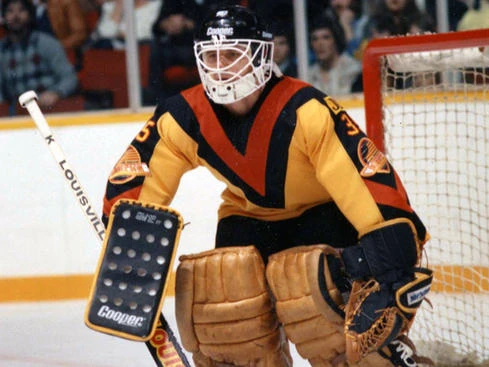
And if there can be rehabilitation for the Astros' notorious uniforms, maybe some others have a chance. The Raptors' old purple shirts still make a lot of appearances in the crowd, despite their tasteful current red and black. The Washington Capitals have brought back their outlandish star-spangled shirts. But the ultimate would be if the Vancouver Canucks and their fans warm to their old black, red, and yellow.

Monday, March 30, 2015

Minor Obstacles

The Chicago Cubs are in the news early this year.  No, they haven't found a way to get eliminated from the playoffs before the season starts.  It's because of their star rookie, Kris Bryant.  In Spring Training, he's hitting .425, with nine home runs in 40 at bats (non-fan's translation: really really good.) 

But this being the Cubs, it can't be that simple.  You'd think that such a strong performance would get him a starting job, but instead, they're going to send him to the minors, at least for now.  Although everyone associated with the team is saying that starting the season in the minors is the best thing for his development, no one really believes that.  The more likely reason for Bryant's demotion is due to the arcane rules governing baseball contracts.  Baseball players spend the first few years of their careers with the team that drafted them. And, if Bryant spends at least the first twelve days of the season in the minor leagues, then this year won't technically count as his first year in the majors, and he'll have to spend an extra year with the Cubs before he gets the opportunity to sign with another team.

So now baseball journalists are having conniptions over this. They're being deprived of seeing one of the most exciting young players (for two weeks) and worried that a team that typically needs all the help it can get will be deprived of a potential star.  And the integrity of the game and all that.

I admit, the situation is pretty stupid.  But I also don't get why everyone is getting so angry over this particular situation.  To understand better, let's look forward over Bryant's career:
  • He spends several productive years with the Cubs
  • In his final year before free-agency, he spends the first half of the year trying to concentrate on the game while his agent attempts to negotiate a new contract, and the second half with the Cubs shopping him around to contending teams.  He eventually gets traded for a prospect no one ever hears from again, and plays out the season for a team that gets eliminated in the first round.
  • He signs a massive contract with the Yankees or Dodgers.
  • He plays the next several years putting up big numbers for a team that chokes in the playoffs every year.  Eventually they win the World Series, he acts like it was the culmination of a long personal journey, while everyone else finds it kind of underwhelming.
  • The Yankees/Dodgers decide they can't afford to resign him, and he spends the downside of his career playing a year or two here and there for second-tier teams that are making a half-hearted attempt to spend with the big boys.
  • He gets named to the Hall of Fame, and the question of which team's cap he's wearing on his plaque becomes a challenging trivia question.

Out of all that, is two weeks in the minors to take advantage of a technicality really the strangest thing, or the thing that damages the game the most?  In our modern world of obscene contracts and revolving-door rosters, the integrity-of-the-game ship sailed a long time ago.

Thursday, October 30, 2014

Great Post, Now I'll Set My Computer On Fire

Of course, I realize people are stupid.  But even given that, I have trouble understanding violence following sports championships.  After the San Francisco Giants won the World Series, two people were shot, two stabbed, 40 arrested, and lots of cars and businesses vandalized.

First of all, let's review the circumstances:
  • It's baseball, the least violent major sport.
  • It's San Francisco, a wealthy, educated, tolerant city.
  • It's their third championship in the past five years.
So if ever a victory was going to result in a big shrug from the winning city, this would be it.  And yet we still saw violence.  On top of that, it's now so expected that if barely even made the news.

The violence-following-championships has gotten so predictable that it's likely a self-fulfilling prophecy now.  If everyone knows that identity-concealing chaos is about to erupt, people will be more likely to act without civility.  A riot is more likely to start if everyone believes a riot is about to start.

Here in Canada, we don't usually riot following one of our teams winning it all.  At least, I don't think we do, it's been so long I don't remember.  But we do trash a city when we lose.  That at least makes some kind of sense, destroying things in anger rather than celebration. But it was, in a way, more embarrassing.  It's one thing to explain to the world that one of your cities burst into violence because of complex psychosocial dynamics.  But we had to explain that one of our cities exploded into violence because we really do get that frustrated over hockey.

Friday, September 26, 2014

Reports Show Joy In Mudville Down Sharply

In the past month, there's been a lot of talk about improving baseball. I guess it's because they've finally got a new commissioner for the first time in about twenty years.

Several news outlets have gotten hold of the bad news in TV ratings: ratings for local broadcasts of games are doing great, but the ratings for national games have dipped badly. It seems that individual teams are popular, but the support for the sport in general is weak. I can relate to that; I've followed the Blue Jays through thick and thin, but don't really pay attention to other games.

So what's the problem? Many sports pundits have lined up to blame it on their personal pet peeves. But a lot of people have focused on the length of games. And I've been impressed with how willing people are too change the game. In the past whenever anyone has suggested that baseball should be sped up, someone - probably Tim McCarver - reassures everybody that the game is perfect and everyone in the stadium is having fun and eating hot dogs and not thinking about being home by ten. But now it seems like everyone's willing to impose time limits on at-bats, ban visits to the mound, or eliminate warm-up pitches.

Impressive, but I don't think this is baseball's real problem. After all, football games are just as long. Here's my take on some of the major problems:

Steroids

People always look at the steroid issues as being about trust. That has been a problem, but here another problem: stats. Baseball has always been bigger on numbers than any other sport, but now it's biggest numbers are meaningless. It used to be exciting when Cecil Fielder or Brady Anderson went above the usual number of home runs. But now, the records have been pushed out of reach, and aren't taken seriously anymore. They should just erase them and make what everyone feels the reality: Maris and Aaron are the record holders again.

Stars

I could write a whole post on how nauseating the Derek Jeter retirement hype has been, but instead I'll just say this: have you considered that he isn't even the best player on his own team? No, I'm not talking about A-Rod, who isn't so impressive anymore (see point one.) No, I mean Ichiro Suzuki. But he doesn't get nearly the publicity, because he played most of his MLB career in Seattle, and to the baseball media, he might as well have stayed in Japan.

Of course, bias to big markets affects all sports, but in most others there is still the possibility for a Kevin Durant, Peyton Manning, or Sidney Crosby to gain national fame from a secondary market. In baseball that's more difficult, even with exceptional accomplishments. Consider Yasiel Puig and Miguel Cabrera: who has the greater accomplishments in the last few years, and who gets the most attention in the media. If you're only going to look to a handful of franchises for your nationally-recognizable stars, you're really limiting yourself.

Anonymous teams

The competitive imbalance that has plagued baseball for years did a lot of damage. It seems to be fixed now, though I'll reserve my final judgement until I see one of these youngster-laden small market teams win the world series.
But a big problem that remains is the transient nature of teams. Big market teams churn through stars they've bought elsewhere, and small market teams are a conveyor belt of prospects that are used for a couple of seasons before being sold to the highest bidder. Wannabe teams either have second-rate fill-ins while they restock the farm system, or they parachute in expensive trades and signings trying to get to the top.

So one way or another, players move all over the place. Yes, there's more player movement in all sports these days, but in the NFL teams can usually hang on to a player for most of their prime, and in the NBA and NHL most teams can afford to at least hang on to a core of players.

But baseball's generous free-agency has lead to a generation of Yankees-Red Sox games that look like all-star games. And now we have to get excited over  Royals-Mariners games featuring players we've never heard of. If you don't have a rooting interest, it's hard to get excited about such arbitrary matches.