Friday, February 10, 2023

Hold This Thread As I Walk Away

Scotiabank has been promoting a new book they're sponsoring, called The Hockey Jersey. The commercials make the point that it's to promote inclusion and tolerance. That's something everyone in hockey agrees is important,  but isn't too good at actually doing. And although Scotiabank are selling physical copies of the book, you can also download a digital copy for free from their website, which is the nicest thing a bank has done since, well, ever. 

It's about a bunch of young girls who come together as a team after they get their own hockey jerseys, which somehow look better than at least half of NHL uniforms. Of course, that title is similar to The Hockey Sweater, the classic story by Roch Carrier, about a boy in Quebec who is mistakenly given a sweater of the hated rival Toronto Maple Leafs, not the Montreal Canadiens sweater he wanted. There is also an animated version from the National Film Board available for streaming.

(As an aside, I love that in the middle of the Wikipedia synopsis of the story, they point out the plot hole: the fateful sweater was ordered from Eaton’s, and Eaton’s pioneered the money-back guarantee, so the mother could easily have returned or exchanged the sweater. Don’t ever change, Wikipedia.)

This being hockey, a lot of people will surely resent something new piggybacking on something old. But I think it gives us an opportunity. Can we finally give The Hockey Sweater a rest? When I was a kid it was really over-used in school. The story was drilled into us so much, one time in junior high, when the teacher announced that we’d be reading a wonderful new story called The Hockey Sweater, the whole class groaned. She was honestly surprised we had not only heard of it but were already sick of it. Now, I find out it was only written in 1979, and thus was a little less than a decade old at the time, so I can understand her not realizing how fast it had saturated the school system.

But it's easy to get why teachers were eager to use it: it's a perfect storm of sports, Canadiana, and situations relatable to kids. Also, looking back, I can appreciate how much of mid-twentieth-century Quebec life he squeezed in: People forced to do business in English, the towering authority of the church, the place of Maurice Richard as a hero. In the eternal quest to find things that will engage students, it sounds like quite a find. 

But there's a problem with The Hockey Sweater that really bugged me - I mean besides it being overused. I've been carrying this around with me ever since, so get comfortable.

It's not really a kids' story. Yes, I know, it's about children, but that doesn't mean they're the target audience. A story can be about children or through the eyes of children without being intended for them. To Kill a Mockingbird, Angela’s Ashes, Lord of the Flies, etc.

Like those books, The Hockey Sweater is pretty dark, when you look at it. The main character doesn't do anything wrong, but ends up a social pariah. His mother doesn't care about his situation. His religion blames him for his problems. And then there's the subtext that his people are trapped in a system rigged against them. Add a murder and it would be hailed as a classic of existentialism. 

An adult can appreciate a story of frustration and futility, but at the time, I found it really depressing. At a young age, children are still expecting stories to have a moral, or at least, to not be a nihilistic commentary of on the futility of life. 

That recounting of unfair situations is also the kind of thing that is best appreciated with a buffer of a few decades to protect you from the raw reality. Sure, now I can read a story about a kid ostracized for wearing the wrong clothes. That’s a common trope of stories about young people. But back then, it was your average weekday. Seeing that happen in a story, with no comeuppance for the bullies or actions by the adults in charge was, well, again: your average weekday. When his only hope for justice is divine-intervention moths, and that’s presented as the punchline, it just seemed hopeless.

So let's retire the Hockey Sweater. Print it on a Syl Apps jersey and lift it into the Bell Centre rafters beside Richard's number 9. That girl in the Scotiabank book can annoy future generations.

Sunday, February 5, 2023

Friday, February 3, 2023

Good Artists Copy

In my post on A.I. art, I tried to create a picture in the style of Roy Lichtenstein, which gives me the rare chance to use the sentence,  "Speaking of Roy Lichtenstein..."

If you're not familiar with him, he was a pop artist whose paintings were in the style of comic book art. I've always liked his work, but now I've seen some criticisms off him online. 

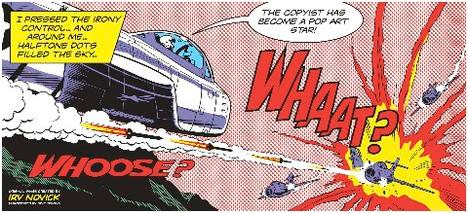
See, when I said his works were, "in the style of comic book art," that's only part of the story. In some cases, they were almost directly copied from comics. 

For instance, here's his much-celebrated painting, "Whaam!"


And it was based on this panel by Irv Novick, from "All-American Men of War." in 1962.


Later, comic artist Dave Gibbons (of Watchmen fame) made this spoof.


I suspect that some of this re-evaluation of Lichtenstein is due to the changing place comics take in our society. When that painting was made, I doubt anyone would have cared that it was copied from a comic book. To my knowledge, no one ever complained that Andy Warhol ripped off the anonymous graphic artist who designed the Campbell's Soup can. At the time, that soup can design was probably esteemed as much or more than the comic artist. I wasn't around for it, but I'm assuming that part of the impact of Lichtenstein's work was the audacity of proclaiming a selection from a comic book as art, just as it was with a grocery item. 

But today, it's quite different. It's not a universal feeling, but most people see comic artists as, well, artists. Copying from them doesn't seem like audacious recontextualization, it just seems like stealing from another artist. 

Wednesday, January 25, 2023

This Team Is A Pinto With 50,000 Miles On It

The big news in hockey this week has been the slow-motion firing of Vancouver Canucks' coach Bruce Boudreau. It's been rumoured that he was on the way out for a while now, and then it was leaked that the team was interviewing replacements, all the while with Boudreau trying to go about his job. It was a surreal, and - most observers agree, cruel - situation.

Although the team's behaviour was roundly criticized, I can't help but think that Canadian hockey journalists are still missing the bigger picture. For one thing, few people have mentioned that this is the second straight season with a mid-season coach-firing for the Canucks, something rarely seen in even the worst-run franchises. 

Then there's the question of the replacement. The coach that management really really wanted is Rick Tocchet. He has six years of experience, but his only playoff appearance was the Covid season where the playoffs were expanded so that three-quarters of the league qualified. Boudreau, on the other hand, has made the playoffs in all but one of his ten complete seasons. Yes, I know, it's become a standard of business that new management wants "their guy," but this stretches the concept to new depths.

My point is that if an NFL team were acting like this, then right about now I'd be writing a post about how I'm sick of the term, "dumpster fire," and we should really come up with some more metaphors for deep organizational incompetence. I don't know, "moldy basement," maybe? But in hockey journalism - in Canada, anyway - people aren't willing to call it what it is.

I see a parallel with how the media talks about players. I've noticed that even if they talk about a play being "dirty," they're unwilling to label the player who does the deed as a "dirty player." And this continues even when it's not his first offence. He's still a Good Hockey guy with lots of Character, just one who happens to make dirty plays on a regular basis. And now the same attitude applies to franchises. The Canucks are a First-Class Organization, that just keeps making stupid or immoral decisions. 

Thursday, January 19, 2023

Toe Beans Of The Apocalypse

Recently on Facebook, I saw a cutesy picture of a cartoon kitten carrying some flowers. It was one of those pictures that was so adorable that it transcended even its own cliched nature. So I'm sitting there thinking, aw cute widdle kitty, when something struck me as a little odd about it. The slightly soft-focus CGI looked eerily familiar...

Then I noticed it: the kitten had six toes on its paw!

What, that wasn’t a dramatic revelation for you? Oh, well, if you're not familiar with that implication, A.I.-generated art is becoming a big controversy, and - despite its leaps-and-bounds in recent years - it’s notorious for getting fingers wrong. So this picture was evidently created by one of the new graphics services that can create a picture for you based on a simple text description.

A few years ago, A.I. art programs just made weird nightmare images. But recently, they’ve been making great strides, and can now do convincing pictures of a wide variety of subjects using just about any style you can think of. But they still have their flaws, including their difficulties with hands and fingers.

That’s kind of a good thing; in the midst of the A.I.-pocalypse, this whole extra-fingers thing is kind of exciting, because it's exactly the kind of contrived plot-point they'd throw into a science-fiction story for convenience, which the fans would forever be complaining about. It's like on Star Trek, where Data couldn't use contractions. 

By the way, I used to think Data’s contractions thing was pretty unbelievable, but then I learned that the laws of contractions really are quite cryptic. They’re a lot more complex than people think they’re.

I've experimented with some of the A.I. art generators, and learned some things about them. There’s Midjourney which is quite powerful, but only free for a limited number of uses, and can only be accessed on the Discord social network. 

Four pictures of an elephant playing basketball
"Elephant playing basketball" by Midjourney

Then there’s Stable Diffusion, which is free to use, though limited in its functionality. For instance, you can’t refine pictures, you can only ask it to try again. Overall, I found its first attempts were a lot better.

Four pictures of an elephant playing basketball
"Elephant playing basketball" by Stable Diffusion

I’d seen some amazing A.I. art on social media, so I enthusiastically tried it out. But I found out that it doesn’t always work. Here’s some of my successes (done with Stable Diffusion.)

A motorcycle in steampunk style in front of a forest background
"Steampunk motorcycle"

A bulbous hippo made of chocolate
"Chocolate hippo"

A thin rabbit in front of bookshelves

"Humanoid nerdy bunny"

A cow attempting to play hockey in a large arena
"Cow playing hockey style of Pixar"

A lego structure resembling actor George Clooney
"George Clooney made of lego"

But a lot of times the results leave a lot to be desired. Here's some of what I've learned:

  • They take refinement. Generally the programs work by producing several attempts. The (human) user can then choose one of those pictures to improve upon. And improving on the pictures, slowly getting closer to the desired outcome, is usually necessary. The impressive examples you see are never the first efforts. Those first attempt are usually half-formed nightmares that look like Scotty's first try working the transporter. 
  • On the other hand, they're great at styles. I've seen them imitate everything from Monet to Rankin-Bass Christmas specials. Even in instances where the application flubbed the content, it usually got the style right.

Several car-like objects rendered in a pop-art style
"Business man driving convertible style of Roy Lichtenstein" by Midjourney. Nailed the style; content, not so much.

Anyway, the deformed kitten was an example of how A.I. art is making its way into the mainstream, and a lot of people are unhappy. For one thing, it’s taking work from artists; though many of the A.I. art programs require a subscription, it’s still pretty cheap, and it’s easy to imagine a small firm opting for that instead of paying an artist every time they need a picture. Then there's also the use of styles. No one is really upset if ol' Monet is getting ripped off, but it can also be used to copy the style of artists and cartoonists that are working for a living today.

A cartoon of a vaguely-Elvis-like rock star
"Elvis style of Gorillaz" by Stable Diffusion

The whole thing is reminiscent of NFT's. On the one hand, you have people who are enthusiastic either because it's an intriguing new technology, or because there's money to be made. So they jump on the new bandwagon. It was weird watching businesses make big announcements about getting into cryptocurrencies or NFT's, only to have howls of protest from customers. The business was then caught unprepared, because they’d spent decades working on the assumption that they had to get into new technologies as fast as possible or be left behind. 

And now it's happening again with A.I. art. Worse, some of the companies that are making the mistake are in the creative industries, and thus supposed to be allies of the artists who are most wary of the new tech. Companies like Adobe and book publisher Tor have had to go into quick damage-control mode.

But there is one way this might work out well: if Big Media starts to protect its intellectual property. For instance, one of the most impressive A.I. pictures I made was "Mickey Mouse in a cafe, painted by Monet." But I’m afraid to put it on this post for fear of getting sued out of existence. That’s one thing that could stop the art-pocalypse in its tracks: some decisive court case, or a strict new law, like how the DMCA was an overreaction to MP3’s. 

Interestingly, using A.I. art for memes, like that kitten, is probably the least controversial use of the technology. It’s not putting anyone out of work. And as I’ve pointed out before, Facebook memes are often hacked-together pop-culture references that completely contradict the creator’s intentions.

So for now, I find the whole thing interesting, but I'm much less enthusiastic, learning that has unpleasant imperfections and implications.

Friday, December 23, 2022

Why She Had To Go, I Don’t Know

Today I saw odd news of a lawsuit over the movie Yesterday. The problem is that there was a trailer for the film that included a scene with Ana de Armas, but she wasn’t in the movie at all, and now a couple of viewers are suing.

First, take this with a grain of salt: although some outlets are reporting it as the studio “losing” the lawsuit, what actually happened is that the studio tried to get the lawsuit dismissed on the grounds that movie trailers are themselves an art form and thus protected by freedom of speech. But the judge ruled that the trailers are just commercials, and thus subject to false-advertising laws, so the trial can begin. But that trial itself has not been decided.

This is one of those case where I don’t know who to cheer for. On the one hand, this is a classic case of America’s litigation culture. Two people rented a movie for $3.99 and are now suing for $5 million. That’s both excessive and super creepy that they think watching Ana de Armas in a supporting role is worth $5 million. But on the other hand, I am — along with many others — really sick of misleading trailers. To be fair, this wasn’t a case of a pre-planned bait-and-switch; de Armas was supposed to be in the movie, but test audiences really hated the subplot she was a part of, so the final cut axed it entirely. But the movie studios have really strained people’s trust for years, and it would be nice if something curtailed that.

It’s just unfortunate how these things so often become all-or-nothing. Yes, it would be nice if studios paid the price for false advertising, but not one studio paying the price for an incident which wasn’t the most egregious example. And it would be nice for movie watchers to get justice, but not a reward for an excessive lawsuit that looks like a disturbing celebrity fixation. The ideal would be some sort of treaty between moviegoers and studios: you start making more honest trailers, and we won’t unleash the Stan army and their lawyers on you.


Saturday, December 17, 2022

Boards Of Canada

There’s been a big change in hockey broadcasting this season: virtual board ads. That is, TV broadcasters can now superimpose fake ads over the real-life ads on the boards. This gives them a chance to do many previously impossible things, like animated ads, or changing ads during play.

Fans are pretty angry. I know, it’s something new in hockey, of course they don’t like it. But in this case, they’re crying wolf with justification. It is pretty annoying. Yes, the advertisers are on their best behaviour, keeping movement to a minimum, but we’ll see how long that lasts. We’ve seen some of the distracting sideline advertising in soccer, and that can’t be far away.

Though I have a couple more complaints: first, this suffers from the same problem as the virtual ads behind home plate in baseball; no concern for insulting our intelligence with geographically-unlikely ads. Like yes, I’m sure Tim Hortons really did pay for a stadium ad at this game in San Diego.

Also, the tech is apparently expensive enough that they can only apply it to the one camera. Switch to a close up, and we have to suffer the old analog boards. I don’t know about anyone else, but I find it disorienting when I see a player pasted against the Hyundai sign, but then from the other angle, he gets a face full of Dunkin’ Donuts.

Having said all this, I have to admire how well it works: 

  • They stay in place very accurately, unlike the on-field ads in the CFL, which — hate to say it — look pretty amateurish, sliding and spinning  around the field.
  • They rarely bleed over top of player uniforms, even white ones, unlike the on-court ads I’ve seen in basketball.
  • Unlike virtual ads in baseball, they don’t suffer from looking crystal-clear, on a field that we’re viewing through 400 feet of rain. Although they sometimes look unnaturally bright, almost like they’re lit up. 

It’s also strange how technology doesn’t work out the way we expect. Soccer and the CFL have had electronic ad boards on the sidelines for years, and I assumed it was only a matter of time until someone made a version of those screens that was durable and flexible enough to be used as hockey boards. But no, virtual technology swoops in for the win. Somewhere out there is an engineer with a half-finished flexible LED panel and a broken heart.